
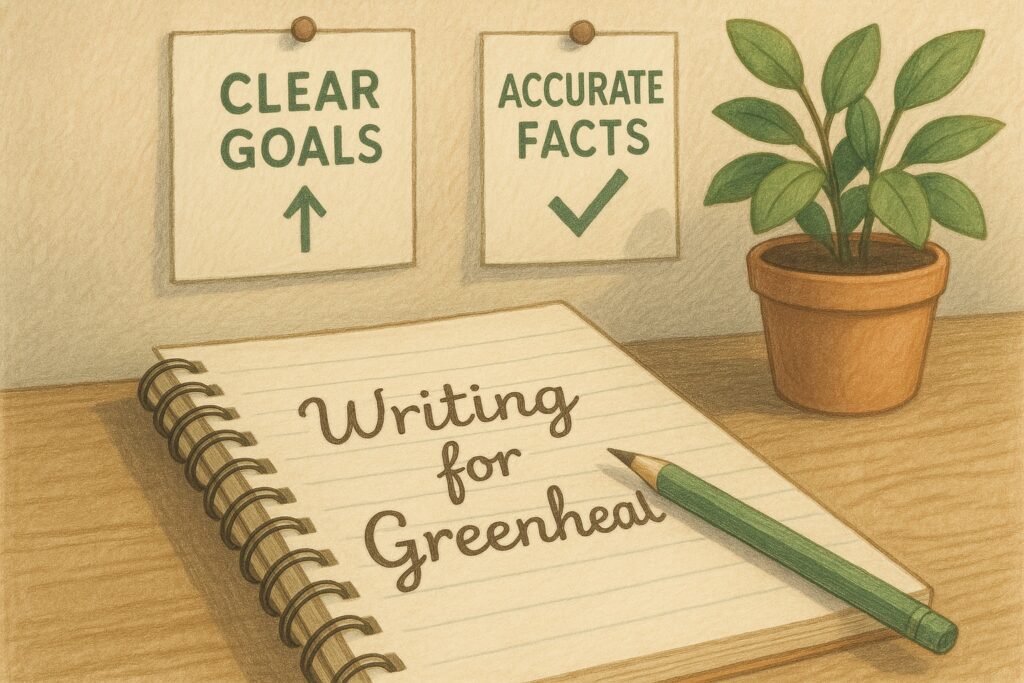
Writing for greenheal blog starts with clear goals and accurate facts. The writer must match GreenHeal’s mission, use reliable sources, and write for readers who want practical environmental health guidance. The piece should stay factual, avoid jargon, and lead with usable advice. The writer must plan sources, verify claims, and present steps readers can follow.
Key Takeaways
- Writing for GreenHeal requires aligning with its mission by providing clear, factual environmental health guidance backed by reliable sources.
- Authors must know GreenHeal’s audience, prioritize verified facts, and present practical steps that readers can trust and apply.
- Transparency is essential; writers should cite credible agencies and studies, clearly noting any uncertainties and data dates.
- Content must be accessible, using plain language, clear structure with action-oriented subheads, and include local context when relevant.
- Writers should prioritize ongoing updates and corrections to maintain credibility and usefulness for readers.
- SEO best practices include naturally integrating target keywords, using schema, and setting meta fields to enhance GreenHeal’s search visibility and reach.
Know GreenHeal’s Audience, Mission, And Editorial Priorities
GreenHeal targets readers who want clear environmental health information. The audience includes concerned citizens, students, and local health practitioners. The writer must write with respect for scientific evidence and public safety. The editorial priority favors verified facts, local relevance, and practical steps.
Writers should open by stating the issue and its impact. They must link the issue to everyday choices and public policy. They should avoid speculation and focus on what readers can do now. The tone should stay calm, confident, and direct so readers trust the content.
GreenHeal values transparency. Writers must list key sources and note dates for data. They must flag uncertainty and suggest next steps for readers. Editors prefer content that cites official agencies, peer‑reviewed studies, or recognized nonprofits. The writer must avoid anonymous claims and unsupported statistics.
Writers should follow site style on accessibility and citations. They must use short paragraphs, clear subheads, and plain language. They should include definitions for terms like exposure, risk, and mitigation when needed. The writer must also add local context when a topic affects specific regions or communities.
The writer must prioritize corrections and updates. If new evidence appears, they should revise articles and add an update note. This practice keeps GreenHeal credible and useful to readers.
Research And Fact‑Check Environmental Health Topics With Credible Sources
The writer must gather primary sources first. They should use government reports, peer‑reviewed papers, and public health agency guidance. They must prefer original data over summary pages. The writer should confirm authors, publication dates, and study limits.
For claims about exposure or health outcomes, the writer must cite studies that include methods and sample size. They should report effect size and uncertainty in simple terms. The writer must explain if results come from lab, animal, or human studies. This clarity helps readers judge relevance.
The writer must check claims against at least two credible sources. They should avoid relying on single news articles or opinion pieces. When a claim relies on modeling or projections, the writer must explain the assumptions and confidence range.
Writers can use authoritative guidance for action steps. For example, they can cite agency recommendations on air quality, water safety, or chemical limits. If an article suggests a home test or behavior change, the writer must cite evidence that the step reduces risk.
Writers should document sources inline or in a short reference list. They must avoid dead links and confirm URLs before publishing. For practical guidance on engaging readers, the writer may follow proven sports writing tips such as the four keys that emphasize clarity and audience focus. The writer must use those techniques selectively to keep scientific accuracy intact.
Write Clear, Actionable Content: Tone, Structure, And Accessibility For Web Readers
The writer must use plain language and short sentences. They should put the main point in the first lines of each section. They must use subheads that state actions or findings. Lists should present steps, risks, and signs to watch for.
The writer should use a consistent voice. They must use third person when describing general advice (e.g., “They should avoid indoor smoke”) and cite sources for specific limits or protocols. The writer must avoid passive constructions that hide responsibility.
Use headings to break content into tasks. Each task section should include a one‑line summary, a short explanation, and a clear action step. The writer must phrase actions with verbs: measure, ventilate, discard, consult. This structure helps readers scan and act.
The writer must include simple visuals or callouts when data is complex. They should add short captions that state the takeaway. If they include numbers, they must round sensibly and explain units.
The writer must check readability and accessibility. They should use 12‑point font for body text, add alt text for images, and label charts clearly. They must format lists with bullets and keep paragraphs under four lines.
The writer must add links to further reading when it helps the reader act. They should use brief anchor text that fits the sentence. They must avoid linking in headlines or the opening paragraph. They must also add a clear correction policy note if the topic carries high uncertainty.
Finally, the writer must follow SEO basics. They should use the target keyword naturally across headings and body. They must add schema where appropriate and set meta fields that match the article focus. This practice helps GreenHeal reach readers who need reliable environmental health guidance.