
Are you taking supplements? Nowadays, it seems like almost everyone does it.
While startup owners in Silicon Valley are experimenting with microdosing LSD, the general public is more interested in boosting their Vitamin D intake and protein levels. There are also those who can’t get a good night’s sleep without melatonin or hydroxyzine.
While dietary supplements can support everyday wellness, they are not a magical cure and should not be treated as real medicine.
How much supplements can help you depends on your situation.
Advertising tends to present a bottle of pills as a near-magical fix. That’s not the case.
Supplements work best when they’re used for what they’re actually good at, like correcting a known nutrient shortage or supporting a particular stage of life. For someone who eats a varied diet and has no trouble absorbing nutrients, taking supplements is usually a waste of time and money.
That’s not to say supplements are useless. Chosen carefully, they can play a reasonable supporting role. During hard exercise, for example, pre workout electrolytes may help maintain fluid and mineral balance.
It all hinges on how you use them and in what circumstances.
Can Supplements Boost Immunity in Otherwise Healthy Adults?
Determining whether someone is healthy or not can be tricky. After all, is feeling mild back pain every morning a worrying sign or just a normal consequence of getting older? Is such a person healthy or not?
The word “boost” carries similar issues. What does it actually mean to boost your immune system?
In truth, the immune system isn’t a dial that goes from weak to strong. It’s a layered set of defenses: skin and mucous membranes, fast-acting cells that respond within hours, and slower ones that learn to recognize a particular virus.
It’s this intricate web of checks and balances that may fail at any of these points. There’s also the issue of autoimmune diseases, where the system turns on itself. It’s both quite fascinating and terrifying.
The bottom line is this — what the body is after is balance.
Deficiencies are easier to fix. We usually fix them with (you guessed it) supplements.
People who are low in vitamin C, zinc, or vitamin D can have weaker immune defenses and catch infections more easily, and getting those levels back to normal helps. That often starts with ordinary food, such as fruit, vegetables, and wholesome options from Circle Organics.
But once someone’s levels are adequate, more doesn’t add up to better. On the contrary, it can have a negative effect on your health. A megadose of vitamin C in January won’t keep a cold away, and it won’t push the immune system past the limits it’s built to work within.
Do Multivitamins Prevent Chronic Disease or Extend Lifespan?
For many people, a multivitamin is as routine as morning coffee, taken in the hope of warding off heart disease, cancer or an early death. The research hasn’t been kind to that hope.
In 2022 the United States Preventive Services Task Force (USPSTF) took another look at the evidence, reviewing 84 studies, 78 of them randomized trials, on vitamin and mineral supplements in healthy, nonpregnant adults. For multivitamins, the results were underwhelming. They didn’t lower the risk of heart disease or of dying from it, and the effect on overall mortality was borderline at best.
Cancer was the one place where something showed up: a small drop in new diagnoses. But it came from only a handful of trials, and one of the largest had enrolled only older male doctors, which made it hard to say whether the result would hold for everyone else. In the end the task force concluded that there wasn’t enough evidence to recommend multivitamins for preventing heart disease or cancer, or to recommend against them.
None of this means a multivitamin is harmful. It just isn’t the insurance policy many people think it is.
How long people live has much more to do with how they eat, move and sleep, the genes they inherit and the environment they live in than with a daily tablet.
Which People May Benefit Most From Dietary Supplements?
1. People With Diagnosed Nutrient Deficiencies
The clearest case for a supplement is a deficiency someone can point to: symptoms, a medical history that makes sense of them, and blood work to confirm it.
When ferritin, 25-hydroxyvitamin D, vitamin B12 or another essential nutrient drops below the normal range, the body starts to cut corners. And once stores are badly depleted, eating better can take months to refill them, which is often too slow.
Iron is a good illustration. Severe iron-deficiency anemia limits how much oxygen the blood can carry, and people feel it as a bone-deep fatigue, foggy thinking, a heart that works harder than it should and workouts that suddenly feel impossible. Rebuilding iron reserves in the bone marrow and liver may take treatment-level doses, not the small amount in a multivitamin.
Severe vitamin D deficiency, for its part, can interfere with bone mineralization and raise the risk of osteomalacia, a softening of the bones. For people in this situation, a supplement is a necessary treatment.
2. Pregnancy, Breastfeeding, and Preconception Needs
Few stretches of life change nutritional needs as much as pregnancy and the months on either side of it. The best-established example is folic acid. The USPSTF recommends that anyone who could become pregnant take 400 to 800 micrograms a day, starting at least a month before conception and continuing through the first trimester.
The reason is timing: the neural tube, which becomes the brain and spinal cord, forms very early, often before a person knows they’re pregnant, and adequate folic acid lowers the risk of defects.
Other needs climb as pregnancy goes on and continue through breastfeeding. Whether everyone with healthy iron levels should take iron while pregnant is still debated. But people who become anemic need it, because blood volume expands significantly and the growing baby draws on the mother’s supply.
DHA contributes to fetal brain development. Iodine is needed to make thyroid hormones, which play their own part in early brain development. Even a careful diet doesn’t always cover all of this.

3. Older Adults and Reduced Nutrient Absorption
Many people in their 60s and 70s eat about as well as they always have, sometimes better. Their bodies, though, don’t always get as much out of that food.
Vitamin B12 is a good example. In meat, eggs and dairy it’s attached to proteins, and the body needs stomach acid to pry it loose. Atrophic gastritis, a thinning of the stomach lining that becomes common after 60, cuts acid production, so a person can eat plenty of B12 and still absorb too little of it.
The B12 in fortified foods and supplements isn’t bound to protein, and absorbing it doesn’t depend on stomach acid in the same way. For that reason public health guidance often recommends those sources for older adults.
Vitamin D is a separate problem. With age, the skin makes less of it in response to sunlight, and the kidneys get less efficient at turning it into its active form. Appetite often shrinks, thirst becomes less reliable and bone density drops faster than it did in middle age. Individually, none of these changes is dramatic. Together, they can leave real gaps. Depending on the person, vitamin D, calcium or an easy-to-digest protein supplement may help with mobility, bone strength and metabolic health.
4. Restrictive Diets and Limited Food Access
Some people need to avoid specific foods. Others don’t have easy access to foods that might help them live a healthy life.
People avoid consuming certain foods for many reasons. Ethics, religion, culture, and allergies are only a few of them.
For vegans, the nutrient to watch is B12. Without eating meat, it’s easy to get B12 deficiency. It can lead to megaloblastic anemia or nerve damage.
Because the body stores B12 for a long time, the deficiency may not show up for years, and by then some of the nerve damage may not be reversible.
Fortunately, B12 supplements are widely available in most corners of the world.
Going strictly gluten-free can also cause problems. In the United States and many other countries, enriched bread, cereal and pasta are a major source of B vitamins, iron and folic acid. Remove them and those nutrients have to come from somewhere else.
Before going on a restrictive diet, carefully consider what supplements you might need. If you’re unsure, contact your doctor or a dietitian.
5. People With Digestive Disorders or Certain Medical Conditions
Absorption happens mostly in the small intestine, and anything that damages or bypasses it can leave the body short.
Crohn’s disease and ulcerative colitis cause chronic inflammation and can speed food through the gut, sometimes leaving patches of injured tissue behind. Fat-soluble vitamins, zinc, iron and electrolytes are among the nutrients most likely to be lost. Celiac disease does its damage differently. In people with the condition, gluten sets off an immune reaction that wears down the villi, the tiny projections lining the small intestine where much of the absorption takes place. Calcium, folate and iron are often low until the lining recovers on a gluten-free diet.
Weight-loss surgery creates a deficiency risk by design. Roux-en-Y gastric bypass, one of the most common procedures, makes the stomach much smaller and sends food around a section of the intestine. Patients typically need high-potency supplements for life, covering vitamins A, D, E and K as well as B12, iron and copper.
Chronic kidney disease, pancreatic insufficiency and cirrhosis of the liver can also affect nutrient needs, and supplements in those cases should be planned and monitored by a doctor.
How Much of a Supplement Should You Take?
Recommended Dietary Allowance, Adequate Intake, and Daily Value
Getting the dose right is critical. Otherwise, you won’t feel the benefits or overwhelm your system.
One helpful resource that you can use comes from the Dietary Reference Intakes, a set of benchmarks developed by the National Academies of Sciences, Engineering, and Medicine.
Get familiar with these three terms:
- Recommended Dietary Allowance (RDA): The average daily amount that covers the needs of nearly all healthy people, typically 97% to 98%, in a given age and sex group.
- Adequate Intake (AI): A best estimate used when the evidence isn’t strong enough to set an RDA. It’s based on what healthy people actually eat, or are estimated to eat, without signs of deficiency.
- Daily Value (DV): The figure the FDA uses on food and supplement labels, so shoppers can see how much of a day’s intake one serving provides.
A label that boasts 500% or even 1,000% of the Daily Value might look good at first glance. But once you understand that it’s either a scam (no one reasonable would offer such a product) or an unnecessary amount of DV, you can search for better products.
Tolerable Upper Intake Levels and Overdose Risk
There’s a ceiling, too. The Tolerable Upper Intake Level (UL) is the most a person can take in each day, counting food, fortified products and supplements together, before the risk of harm starts to rise for most healthy people. Go above it regularly, and the odds of toxicity, strain on organs and other side effects go up with it.
That risk isn’t theoretical. Data from U.S. emergency departments suggests that supplements are behind more than 23,000 emergency visits a year, along with thousands of hospital admissions. Many of those cases involve a racing heart, an irregular heartbeat or chest pain after someone took an energy, weight-loss or sports product. Others come down to too much of a single vitamin. Adding up everything you take and comparing the total with the UL is a simple way to avoid an accidental overdose.
How Age, Sex, Diet, and Health Status Affect Dosage
There’s no single right dose for everyone. Needs shift with age, sex, body size, metabolism and medical history. Iron shows how wide the gap can be. Premenopausal women generally need about 18 milligrams a day, more than twice the 8 milligrams recommended for adult men and postmenopausal women, because of the iron lost each month through menstruation. For a man or a postmenopausal woman without any ongoing blood loss, a high-iron supplement can tip the balance the other way, toward iron overload, which can damage the heart, pancreas and liver.
Age changes what’s safe as well. Babies and young children tolerate much smaller amounts of certain vitamins and minerals, and a dose meant for an adult can poison a toddler. At the other end of life, older adults may need more vitamin D and more easily absorbed B12, but less preformed vitamin A, since an aging liver may clear it more slowly. The right amount depends on who’s taking it, not just on what the label suggests.
How Can You Choose High-Quality Dietary Supplements?
Reading the Supplement Facts Label
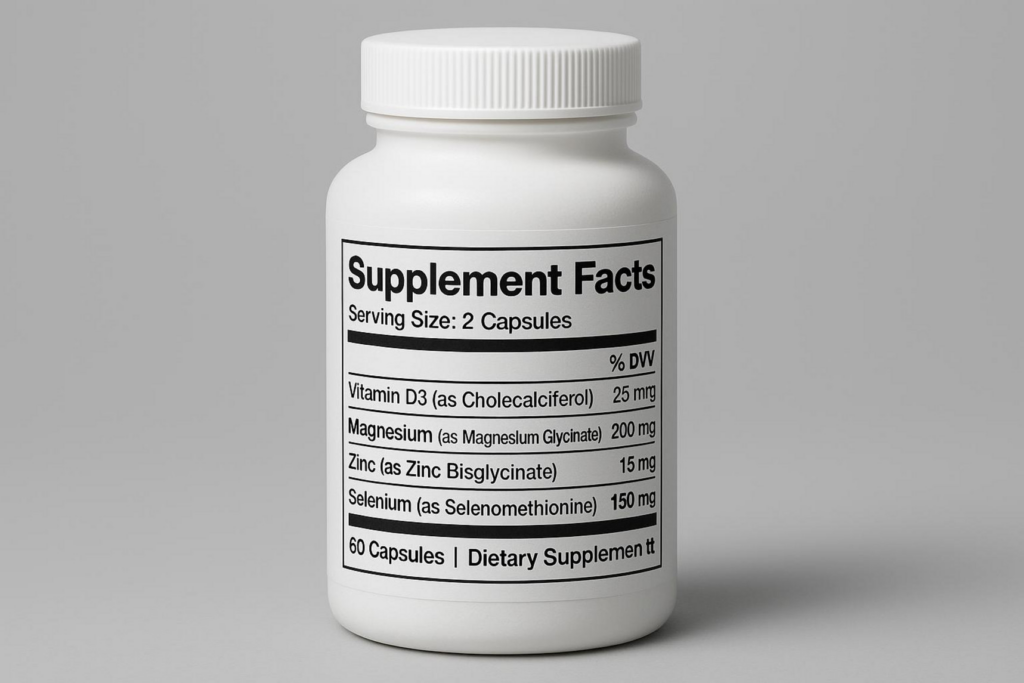
The front of the bottle is marketing. The useful information is on the back, in the Supplement Facts panel. That’s where you’ll find the serving size, the form of each ingredient, how much of it is in each serving and what share of the Daily Value that covers. The form matters more than most shoppers realize. Magnesium, calcium, zinc and iron can come as an oxide, carbonate, citrate or chelate, and those versions differ both in how well they’re absorbed and in how kindly they treat the stomach.
Be wary of anything labeled a “proprietary blend,” “matrix” or “complex.” These group several ingredients under a single total weight. Companies say that protects their formulas, and it does, but it also keeps buyers from knowing how much of each ingredient they’re getting. A blend can feature a fashionable, expensive compound in the name and contain only a trace of it, with cheaper fillers making up the rest. Brands that have nothing to hide list every ingredient with its exact amount, usually in milligrams.
What Third-Party Testing and Certification Can Show
Because the government doesn’t check supplements for purity or potency before they’re sold, independent testing is one of the few ways to know what’s actually in the bottle. Organizations such as the United States Pharmacopeia (USP), NSF International and ConsumerLab buy or collect products sold to consumers and test them.
A third-party seal generally indicates that:
It’s worth being clear about what a seal doesn’t mean. It tells you the product is what it claims to be and was made properly. It says nothing about whether it treats a disease or will do what you’re hoping it will.
Recognizing Unsupported Health Claims and Misleading Marketing
Under federal rules, supplement labels can make what are known as structure/function claims, like “supports joint flexibility” or “helps cellular energy production.” What they can’t do is say that a product cures, prevents or treats a disease. That line has produced a whole vocabulary of careful phrasing designed to suggest a medical benefit without quite claiming one, and it’s worth reading with some skepticism.
Certain words are reliable warning signs: “miracle,” “breakthrough,” “rapid melt,” “ancient clinical secret.” Real changes in the body tend to happen slowly, if they happen at all. Dramatic before-and-after testimonials deserve the same suspicion, as do vague nods to “science” with no study attached. And when a study is cited, it helps to check what kind it was. A result in cells in a dish or in a handful of mice doesn’t show that something works in people. As a rule, the easier a product makes it sound, the further it has probably drifted from the evidence.
Why Supplements Cannot Be Approved as Effective Before Sale in the Same Way as Medicines
A bottle on the shelf at a major pharmacy chain can look as official as anything behind the counter, and many people assume the FDA has signed off on it. It hasn’t. Before a prescription drug can be sold, it has to pass several phases of human trials showing that it’s safe and that it works. Supplement makers face no such requirement. They can bring a product to market without first giving the FDA clinical data on safety or effectiveness, as long as its ingredients were sold before October 1994 or are generally recognized as safe. Ingredients introduced after that date do require the company to notify the FDA and provide evidence of safety, but that’s still a far lower bar than drug approval.
So most oversight happens after the fact. Rather than the manufacturer proving a product is safe before it’s sold, the burden falls on regulators to build a strong case that it’s adulterated, mislabeled or unsafe before they can issue warnings, push for a recall or restrict sales. That arrangement is the main reason so much of the checking, from labels and testing to ingredients and safety information, ends up being left to the buyer.
How Can Supplements Fit Into an Everyday Wellness Plan?
Start With Dietary Habits and a Clear Health Goal
Supplements work best as the last layer of a healthy routine, not the first. The groundwork is unglamorous and familiar: a varied diet built mostly on whole foods, enough sleep, regular exercise, some way of managing stress and enough to drink. Once that’s in place, a supplement can be brought in for a specific reason, one you can actually measure.
That reason is worth settling before you buy anything. Taking a handful of pills to “feel healthier” leaves you with no baseline and no way of knowing whether they did anything. A narrower goal is easier to judge. Someone with a 25-hydroxyvitamin D level of 20 ng/mL might take vitamin D with the aim of getting it to 40, then retest to see if it worked. Someone starting a strength-training program might add creatine to support it. In both cases, there’s a result to check against.
Track Benefits, Side Effects, and Changes in Medication
Start new supplements one at a time. If you begin four on the same morning and a week later notice more energy, an upset stomach or a rash, there’s no telling which one was responsible. Spacing them out over several weeks makes your body’s response far easier to read.
It also helps to keep a record, in a notebook or on your phone. Note the start date and the dose, and jot down any changes in energy, sleep, digestion or how you feel in general. The unwelcome changes belong there, too: nausea, heartburn, headaches, a heart that races for no obvious reason. And whenever a doctor changes one of your prescriptions, go back over the supplement list right away to make sure the new treatment doesn’t clash with anything else you’re taking.
Review Supplement Use Regularly With a Qualified Professional
What made sense to take a year ago may not make sense now. Diet, health, activity levels and stage of life all shift, and needs shift with them. A supplement that helped during a hard training block, a punishing stretch at work, a pregnancy or recovery from surgery may have quietly outlived its purpose. Taking it out of habit costs money and, in some cases, raises the chance of getting too much of a nutrient.
A yearly review with a doctor or registered dietitian is a good way to keep things in check. Bring every bottle you use, go over your most recent blood work and ask, for each product, whether there’s still a good reason to take it. Dropping duplicates, extras and products with little evidence behind them keeps the routine simpler and tied to what your body actually needs.
Small practical details make a difference as well. Fat-soluble vitamins are absorbed better with a meal that contains some fat. Calcium and iron compete with each other in the gut, so it can help to take them at different times of day. Heat, light and humidity can break down some active ingredients well before the expiration date, which makes the bathroom cabinet, steamy after every shower, one of the worst places to keep them. A cool, dark kitchen cupboard is a better bet, and it helps whatever you’ve chosen to take stay stable and do its job.