
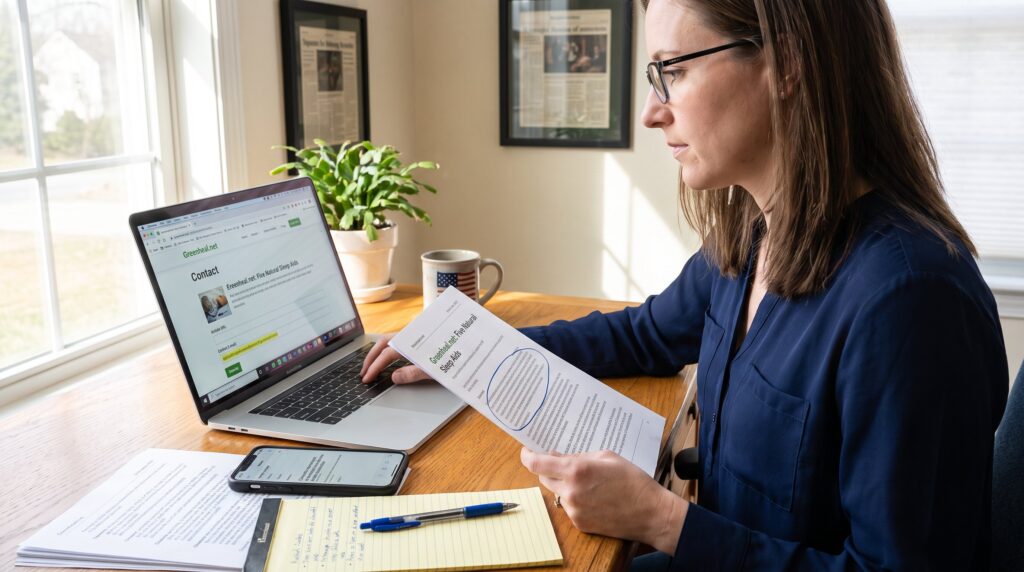
How to Contact Greenheal.net About a Health Article is a common search when readers find an error, want clarification, or propose an update. This guide explains, step by step, where to send an inquiry, how to write a short actionable message, what to include as evidence, and sensible follow-up timing. It assumes the reader wants a clean, verifiable outcome, correction, citation, or editorial response, and focuses on practical channels and phrasing that get results without drama.
Key Takeaways
- To contact Greenheal.net about a health article, use the website’s contact form for short reports or the editorial email for detailed, evidence-backed requests.
- Start your message with a clear purpose sentence and include the article title, URL, exact quoted text, and supporting evidence to ensure quick verification and response.
- Attach documents only when necessary; otherwise, provide full citations and offer to send attachments if requested, following the site’s writing guidelines for clarity and neutrality.
- Expect an automated receipt immediately, an editorial acknowledgment within 3-7 business days, and a final decision within 1-3 weeks depending on complexity.
- If you receive no response after 7-14 days, send a polite follow-up summarizing your request and offer further evidence to facilitate progress.
- In critical cases posing public safety risks, escalate the inquiry promptly with clear risk descriptions while maintaining professional communication to encourage cooperation.
Contact Channels: Where To Send Your Inquiry
Fact first: send inquiries through the website contact form or the editorial email listed on the site, those routes get the fastest official attention.
Greenheal.net lists contact routes on its contact pages. If a reader prefers forms, the site’s contact page form routes messages into the editorial workflow. For email, look in the site footer or the About pages for an editorial or general info address. If a topic is time-sensitive (for example, an urgent factual error in a health piece), using the editorial email is usually better than a general feedback form.
Practical options and when to use them:
- Contact form: use for short, structured reports and when the form asks for article URL and details. It generates an automated receipt.
- Editorial email: use for longer evidence-backed requests or when attaching source documents.
- Social channels: use only for brief flags (example: a tweet noting an error), then follow up through official channels.
Examples of where to look on Greenheal.net: the site’s dedicated contact pages explain options, response times, and tips for what to include. Readers trying to find the fastest route can compare the site’s contact choices on the contact page for the blog and the main site.
Internal resources that help identify the correct contact path: readers who want the site-wide contact overview can use the page about how to get in touch with Greenheal for clear options and expected response windows: contact, greenheal, options, get, touch, response. For blog-specific queries, the team recommends the blog contact page which covers email and social channels: contact, greenheal, blog, email, social.
Preparing Your Inquiry: How To Write A Clear, Actionable Message
Fact first: state the purpose in the first sentence, for example, “Requesting correction to statistics in the article titled X.” That single move speeds triage and reduces back-and-forth.
Open with a one-line purpose, then list the problem in short, factual bullets. Keep paragraphs to one or two sentences each. Use neutral language: avoid accusations and speculation. Say what action is requested (correction, citation, clarification, removal) and give a realistic deadline if the issue affects reader safety or public guidance.
Concrete structure to follow in the email or form:
- One-sentence purpose. Example: “Correction request: in ‘Five Natural Sleep Aids’ the caffeine statement conflicts with current guidance.”
- Article identifier: title and full URL.
- Quoted text: copy the exact sentence you question.
- Evidence: attach or cite a clear source (guideline, peer-reviewed paper, or official agency statement).
- Your details: name, role, and contact method.
A practical example: a clinician emailing to request a change might write the purpose line, paste the article URL, quote the disputed sentence, and attach a one-page PDF with the guideline excerpt (including page numbers). That combination makes it straightforward for editors to verify and act.
Contextual help and writing standards: newcomers who want guidance on tone and content structure can consult the site’s writing guide for contributors: it shows how Greenheal prefers clear, evidence-based submissions: greenheal, guide, health, write, sustainable, content.
Note, encourage attachments only when necessary. Many forms block attachments: in that case, include full citations and offer to send supporting files if requested.
Key Details To Include In Your Message (Author, Article, And Evidence)
Fact first: include the article title, URL, author name (if shown), the exact quoted text in question, and at least one trustworthy supporting source.
Why these elements matter: editors need to match the report to the correct page, locate the passage in context, and verify the claim without chasing the reporter for basic facts. Missing the URL or exact quote doubles verification work and delays action.
Precise examples readers should include:
- Article title and the full article URL (copy from the browser address bar).
- Author name and publication date as shown on the page.
- Exact wording: copy-paste the sentence or paragraph and put it in quotation marks.
- Supporting evidence: a guideline PDF, a DOI-linked peer-reviewed article, or an official agency statement with citation details (author, year, journal, page).
Numbers and citation style: give page or section numbers when possible. For example, “NICE guidance, section 2.3, page 14” or a DOI such as “10.1001/jama.2024.12345” lets editors retrieve the source instantly.
If the sender has credentials, state them briefly. For instance: “Dr. Maria Santos, MD, Clinical Pharmacologist” adds weight but is not required. If the sender represents an organization, add a contact phone and a short note explaining any conflict of interest.
Related site resources: for readers checking where similar corrections have been handled, Greenheal’s practical wellness guides and site blog show how the editorial team frames corrections and updates: consult the site’s practical resource hub for context: natural wellness guides.
What To Expect After You Contact Them And How To Follow Up
Fact first: expect an automated acknowledgement for form submissions and a review that may take several business days: complex issues take longer.
Typical timeline and signals:
- Automated receipt: within minutes for forms.
- Initial human acknowledgement: often within 3–7 business days.
- Editorial review and decision: 1–3 weeks depending on complexity and need for external verification.
If no response arrives after 7–14 days, send a polite follow-up citing your original message and date. Keep the follow-up short: one sentence restating the request, one sentence offering additional evidence, and one sentence asking for an estimated timeline. Example: “Following up on my correction request sent May 2: happy to provide the PDF of the guideline if helpful, can you advise an ETA?” That wording is assertive without antagonism.
When an editor replies, expect one of three outcomes: confirmation of correction, a request for more information, or a reasoned refusal. If Greenheal agrees to correct, ask when the change will appear and whether they will add an editor’s note. If they refuse, request a brief explanation of the review finding so the sender can address any gaps.
Practical follow-up example and escalation: if the issue involves potential harm or clear public-safety misinformation and the site does not respond within two weeks, escalate by resending the email marked “urgent” and include a short sentence describing potential risk. For persistent non-response, consider posting a concise, factual voice on the site’s suggested channels and linking to an external guideline: but, keep communication professional to preserve a cooperative relationship.
Additional internal reading: for those tracking site updates or editorial policy changes that might affect response handling, consult the page summarizing what’s new and editorial features: new, greenhealnet, updates, features, whats, latest.
Conclusion
For practical results, start at Greenheal.net’s contact form or editorial email, lead with a clear purpose sentence, include precise article details and one strong source, and expect a review process that can take days to weeks. Follow up politely after 7–14 days and provide additional evidence when requested. Readers who adopt this approach increase the chance of a timely correction or clarification while keeping the relationship with the editorial team cooperative.