
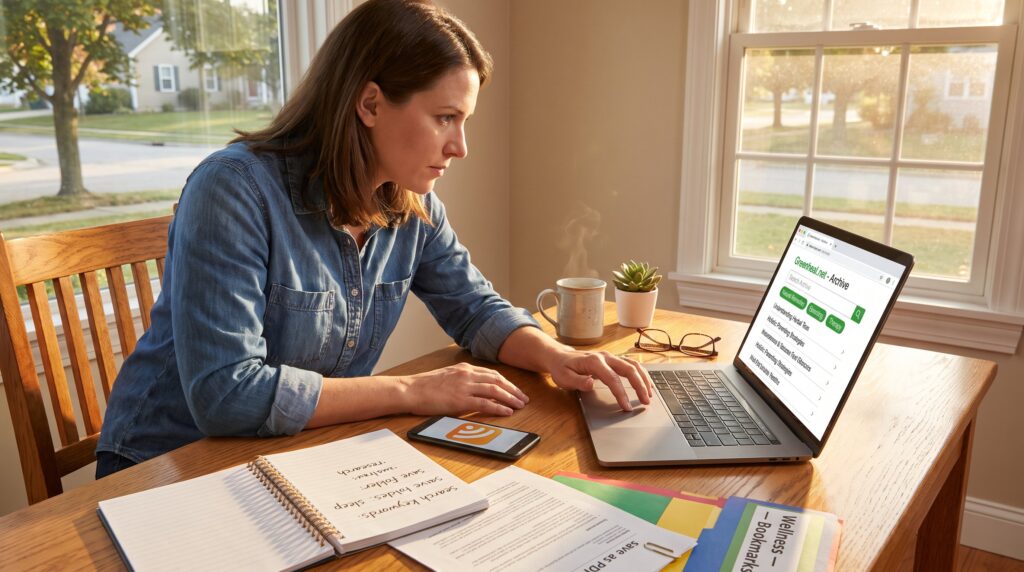
How to Browse the Greenheal.net Article Archive opens with a promise: a practical path to find trusted health, wellness, and lifestyle content fast. The archive contains thousands of posts on natural remedies, recovery, parenting, and mental health. This guide shows which sections matter, how the site structures content, precise search tactics, and ways to save or track useful articles without wasting time.
Key Takeaways
- The Greenheal.net article archive offers focused, practical content on health, wellness, and lifestyle topics including natural remedies, recovery, and parenting.
- Browsing begins effectively by selecting relevant categories like Addiction, Natural Remedies, or Therapy, then refining with tags and dates for precise results.
- Use concise keywords and Boolean operators in site or Google site searches to quickly locate specific articles within the Greenheal.net archive.
- Tag pages function as micro-hubs, providing concentrated series of articles on trending or specialized topics for efficient research.
- Save and track useful articles with browser bookmarks, RSS feeds, or newsletters to stay updated without repeated searching.
- Always verify clinical and therapy advice with established health libraries and note publication dates to ensure current accuracy.
Why Use The Greenheal.net Archive For Health, Wellness, And Lifestyle Research
Greenheal.net’s archive offers focused, practical articles on recovery, natural remedies, parenting, and everyday self‑care. For a reader who needs applied advice, say, a parent looking for home skin care after insect bites or someone researching therapy options after an accident, the archive groups usable how‑tos, community tips, and trend pieces in one domain. That focus reduces noise compared with general news sites.
The archive is valuable because it combines topical coverage with dated posts, letting researchers track how a topic evolved. For example, a search on therapy after injury returns clinical‑adjacent posts, community stories, and recovery checklists that reference documentation practices. To assess reliability quickly, readers can cross‑check Greenheal pieces with methodical directories. One helpful comparison point is an A–Z health library such as the one maintained by Harvard Health Publishing which demonstrates condition‑based archives organized for clinical clarity.https://www.health.harvard.edu/health-a-to-z
Why pick Greenheal.net for everyday research? It blends practical home remedies, lifestyle guidance, and mental‑health resources in one place. For a fast orientation to the site’s broader self‑care mission, consult a short primer on the site’s core guides that outlines its wellness pillars and article types: core guides.
How The Archive Is Organized: Categories, Dates, And Topic Hubs
Greenheal.net organizes content in three straightforward ways: category archives, chronological listings, and tag‑based hubs. The category layer groups broad topics such as Healthy Lifestyle, Latest, and Therapy. Within each category, posts display their publication date so a researcher can read in chronological order and spot trends or updates.
Tags act like micro‑hubs. Tags such as “News and Updates” or topic names gather brief series of articles. Date ordering is visible on category pages, so someone researching a developing issue can start with the latest and step backward. For botanical and product‑based content, Greenheal also maintains product category pages. To inspect plant‑focused posts and product listings, try the site’s plant collections, which group articles and product notes by species and use, for example the plants archive and the cacti archive.
Practical tip: begin on the category most likely to contain your answer, then refine by tag or date. That flow, from broad category to tag to specific date, saves several rounds of blind searching.
Key Sections To Know Quickly (Addiction, Natural Remedies, Parenting, News, Therapy, Slots)
Addiction and recovery: Greenheal.net lists posts on addiction, coping strategies, and documentation for recovery claims. These pieces often include steps for seeking help and links to professional resources.
Natural remedies: Expect recipes, oil‑based treatments, and specific how‑tos, e.g., home treatments for bug bites or uses of herbal salves. Readers seeking concentrated guidance on natural solutions will find curated how‑tos and product notes.
Parenting and family wellness: Articles include childproofing tips, community support ideas, and accessible language for caregivers managing chronic conditions in the family.
News and updates: The News tag groups timely wellness developments, regulatory updates, or community announcements.
Therapy and mental health support: This section covers trauma effects, therapy options, and practical steps for documenting symptoms. Those seeking clinical next steps will find referral guidance and self‑care recommendations.
Slots: Occasionally, the archive links to casino or slots content through external partners or affiliate pages. That material is not core to Greenheal’s wellness mission but appears in some site areas and external references.
If a reader wants a consolidated route through natural‑remedy content, Greenheal provides a focused entry that aggregates guides and practical recipes at how to find natural remedy articles. For evaluating advice quality across these sections, consult a short checklist at evaluate wellness advice.
Effective Search Strategies: Keywords, Filters, And Boolean Techniques
Start with a clear fact: concise keywords plus simple filters find relevant Greenheal posts faster than long questions. Use two‑ to three‑word phrases that pair topic and context, for example, “natural remedies bug bites” or “mental health accident documentation.”
Apply Boolean operators in the site’s search field or external search box. Use AND to narrow (mental health AND accident), OR to widen (anxiety OR stress), and quote marks for exact phrases (“natural remedies”). Combine category filters with dates to find the most recent practical guidance.
When the on‑site search is limited, switch to Google site search for precise results. Use the pattern site:greenheal.net plus keywords to surface in‑domain matches. For example, site:greenheal.net “natural remedies” returns posts that include that exact phrase. That external tactic mirrors what large health libraries do when cyclists, clinicians, or journalists want in‑site recall across many small pages.
Practical warning: tag names sometimes overlap (e.g., “News” vs “News and Updates”). If a search returns too many hits, add a category term or a year (2024) to narrow results quickly. For a guided starting point on self‑care topics that map to tag structures, readers can use the site’s practical directory entry for an organized path through the site’s wellness content: www guide.
Using Site Search, Tags, And Google Site: Search For Precise Results
Fact first: the most reliable technique for precision is the combination of site search + tag filters + Google site: queries. If Greenheal’s internal search returns many unrelated hits, copy the exact phrase and run a Google query like site:greenheal.net “term” to prioritize pages that include the phrase across titles and body text.
Tags are especially handy for topic hubs. Open a tag page and scan the first ten results: these are usually the most relevant. For trending topics, check the tag’s newest posts and then use the category view to confirm whether the piece is part of a larger series.
For finding curated natural‑remedy lists or step‑by‑step self‑care ideas, the site maintains a practical collection that aggregates those kinds of posts. Readers can jump directly to example compilations like self‑care ideas and scan curated lists rather than single posts. This saves hours compared with hunting one article at a time.
Save, Subscribe, And Track Articles: Bookmarks, RSS, And Newsletters
Direct answer: use browser bookmarks, RSS feeds, and newsletters to track Greenheal content without repeated searches. Bookmark a useful article in a themed folder (e.g., “bug bite remedies”) so a reader can return quickly. For active monitoring, add any available RSS feed to an aggregator: an RSS tool sends new posts into a single reading list.
If the site offers a newsletter, subscribe to catch curated updates and summary digests. Newsletters typically surface high‑value posts and often include topic bundles (for instance, a recovery bundle or parent wellness tips). If a reader needs offline access, save articles as PDFs and tag them in a notes app with short descriptors like date, category, and why it mattered.
Honest assessment: not every article will age well. When saving clinical or therapy guidance, the reader should note the publication date and verify recent clinical guidance with established health libraries.
For structured navigation of the site’s archive and to connect saved items to broader primer content, use the site’s main wellness guide that links topical paths and curated series: site primer.
Conclusion
Greenheal.net’s archive becomes workably powerful when a reader combines category browsing, tag hubs, precise keywords, and external site searches. Save important posts, follow any RSS or newsletter options, and cross‑check clinical claims when necessary. With those steps, Greenheal serves as a practical repository for everyday wellness and lifestyle research.