
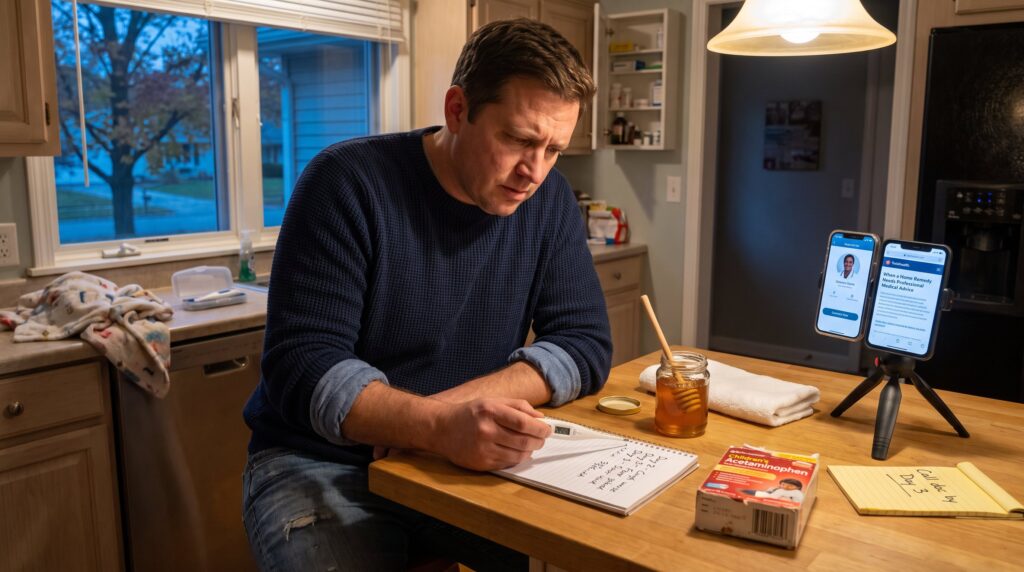
When a home remedy needs professional medical advice, people must recognize clear limits fast. Home treatments help with mild, short-lived symptoms such as a runny nose or minor aches, but they can delay necessary care when warning signs appear. This guide explains why people try DIY care, the concrete red flags that demand attention, how long to wait before seeing a clinician, and which risk factors lower the threshold for professional help. Practical examples and precise timeframes make it simple to decide what to do next.
Key Takeaways
- Home remedies effectively address mild symptoms but require honest monitoring to avoid delays in professional care.
- Recognize red flags like worsening symptoms, new severe signs, or inability to perform daily activities as signals to seek medical advice immediately.
- Set a clear timeframe for home treatment, typically 3–7 days, and consult a clinician if symptoms do not improve or worsen within this period.
- Urgent symptoms such as chest pain, sudden breathlessness, seizures, or persistent vomiting demand immediate emergency care rather than home remedies.
- Individuals with risk factors like chronic diseases, pregnancy, or immunosuppression should seek medical advice sooner, often within 24–72 hours of symptom onset.
- Children, infants, and pregnant people require prompt professional evaluation for even minor or early symptoms to prevent complications.
Why People Turn To Home Remedies And When They Can Be Effective
People choose home remedies for convenience, cost, and culture. They reach for honey for a sore throat, warm compresses for sprains, or steam for congestion. The fact: home remedies work best for mild, self-limited problems that are improving and do not stop normal daily activity. For example, a person with an ordinary cold who has clear nasal drainage, no fever above 38.5°C (101.3°F), and steady energy can safely use rest, fluids, and over-the-counter products for 3–5 days. Anecdote: a parent who eased a toddler’s mild fever with acetaminophen and a lukewarm bath saw symptoms fall within 48 hours, a textbook mild course.
Why this matters: DIY care can reduce unnecessary clinic visits and save money, but it requires honest monitoring. Greenheal’s resources on natural remedies list safe, practical options and show which symptoms usually respond at home. Readers should pair simple treatments with a clear plan: set a time limit, note any worsening signs, and escalate if daily function drops.
Red Flags: Signs Your Home Remedy Isn’t Working Or Is Making Things Worse
Answer: Stop the home remedy and seek medical guidance when symptoms worsen, recur, or last longer than expected. Clear examples: a cough that grows louder and more frequent over two weeks, persistent vomiting causing weight loss, or abdominal pain that keeps a person from eating. The concrete sign: new spreading redness, pus from a wound, or increasing weakness are objective clues that a problem has progressed.
Practical check: use a daily symptom log, note temperature, pain scale (0–10), appetite, and sleep. If metrics degrade for 48–72 hours even though treatment, the home remedy is failing. A real-world mistake: someone treating a deep cut only with home antiseptics waited five days while redness spread: the result required antibiotics and a clinic visit. Avoid that delay. For practical next steps, the resource guide offers additional detail.
Contextual link: For readers deciding whether to keep self-care or see a clinician, Greenheal’s guidance on how to evaluate wellness advice helps differentiate reliable tips from risky ones.
Urgent Symptoms That Require Immediate Medical Attention
Answer: Certain symptoms need immediate care, do not try home remedies first. Chest pain or pressure, sudden shortness of breath, fainting, seizures, sudden weakness on one side, trouble speaking, or sudden vision loss all require emergency services. In children, fast or difficult breathing, bluish skin, inability to wake, or persistent vomiting are urgent.
Examples and numbers: chest pain plus sweating and nausea can indicate a heart attack: every minute counts. Seizures lasting longer than five minutes or repeated seizures without recovery need emergency intervention. Severe uncontrolled bleeding or large burns need immediate care to prevent shock. For infants under three months, any fever is a red flag and warrants evaluation.
Evidence link: The Mayo Clinic explains why “natural” does not equal safe and why dangerous symptoms should prompt professional assessment rather than continued home treatment: clinical safety guidance.
How Long To Try A Home Remedy Before Seeking Professional Help
Answer: Try a home remedy for a few days for mild problems, but seek help if there’s no steady improvement within 7–10 days or sooner if symptoms impair daily life. Concrete rules: minor sore throat or cold, re-evaluate after 3–5 days: uncomplicated sprain with decreasing pain, recheck at day 5: persistent cough beyond two weeks requires evaluation.
Practical timing plan: set a hard deadline in writing when starting self-care. For instance, an adult with low-grade fever and congestion should note symptom day 1 and contact a clinician by day 7 if no better. If symptoms disrupt work, sleep, or eating earlier, call before the deadline. A common human error: treating worsening sinus pain at home for ten days before seeking care, which allowed a bacterial sinus infection to worsen: earlier antibiotics would have shortened recovery.
Support link: For basic cold-care steps and red flags, MedlinePlus supplies clear at-home treatment advice and timelines for escalation: cold care instructions.
Risk Factors That Lower The Threshold For Seeking Medical Advice
Answer: Certain risk factors mean a lower tolerance for symptom persistence or severity. Specifically, chronic heart disease, diabetes, chronic lung disease, pregnancy, older age, and immunosuppression demand earlier medical review even for mild symptoms. Why: these conditions can mask danger signs and make infections or complications progress rapidly.
Example: a person with diabetes and a small foot blister should see care sooner because high blood sugar raises infection risk and delays healing: a rapid clinic visit can prevent deep infection. Numbers matter: immunocompromised people on steroids or chemotherapy can move from mild cough to pneumonia in days. Practical advice: anyone with one of these risk factors should reduce the self-care trial window to 24–72 hours and contact a clinician at the first sign of worsening.
Related internal link: Greenheal’s article on how at‑home detox adds comfort explains safe limits for self-care in recovery contexts and why medical oversight matters for higher-risk people.
Who’s At Higher Risk: Children, Pregnancy, Chronic Conditions And Immunocompromised People
Answer: Children (especially infants), pregnant people, those with chronic conditions, and immunocompromised individuals should consult professionals sooner and avoid relying solely on home remedies. Concrete scenarios: any fever in an infant under three months needs evaluation: pregnant people with fever, bleeding, or persistent pain require prompt assessment because complications can affect both mother and fetus.
Data point: infants and young children can decompensate quickly: fast breathing or poor feeding are objective danger signs. Those on immune-suppressing medication may not mount typical fever responses, so even subtle changes, new fatigue, slight cough, or a nonhealing sore, warrant contact with a clinician. Real lesson: a family delayed care for a newborn’s low-grade fever and later needed hospitalization: earlier evaluation likely would have prevented escalation.
Cluster links: For practical reading and self-care options tailored to families, Greenheal provides a path to find appropriate articles and ideas: how to find natural remedy articles and self-care ideas for safe home strategies that still respect high-risk rules.
Conclusion
Insight: Home remedies are useful but not unlimited. If symptoms worsen, new severe signs appear, or the person has risk factors, seek professional medical advice promptly. Practical takeaway: document symptoms, set a clear deadline for self-care, and use trusted Greenheal resources to choose safe options. When in doubt, earlier evaluation prevents complications and often shortens recovery.