
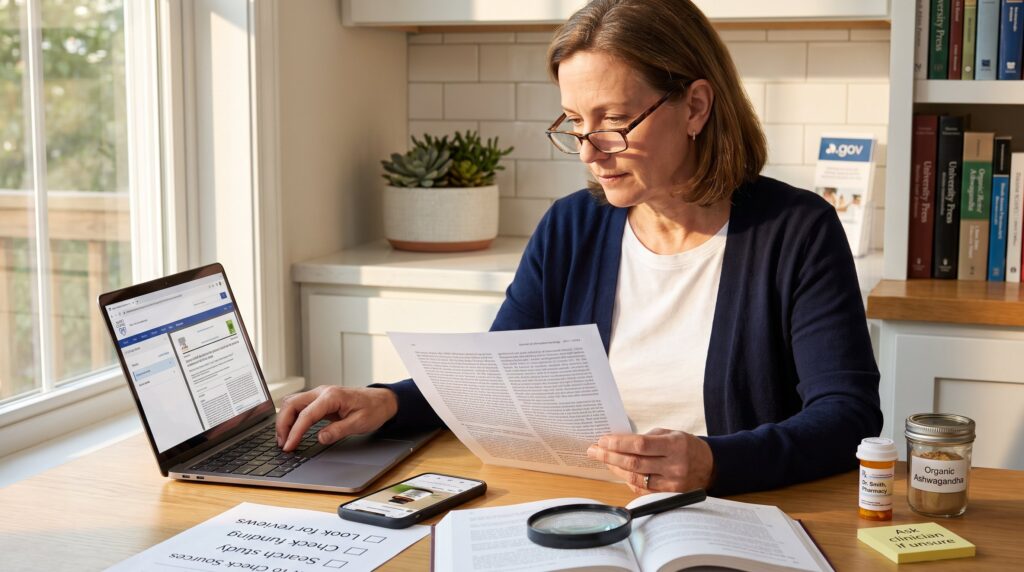
How to Check Sources Behind Natural Health Claims matters now more than ever. With social posts, sponsored articles, and product pages pushing quick fixes, readers need a compact method to tell solid evidence from marketing spin. This guide gives clear, actionable steps they can use immediately to verify whether a natural‑health claim rests on peer‑reviewed studies, reputable institutions, or anecdote and hype.
Key Takeaways
- Checking sources behind natural health claims is essential to avoid harm and costly mistakes by verifying evidence from reputable institutions and peer-reviewed studies.
- Use a repeatable checklist to identify original claims, check author credentials, assess publication outlets, and verify study quality and conflicts of interest.
- Look for consensus among multiple independent studies and recent guidance from major health organizations to confirm a natural health claim’s reliability.
- Be cautious of claims lacking peer-reviewed evidence or funded by parties with potential conflicts of interest, as these reduce credibility.
- A quick 5–10 minute verification involving searching trusted sources, reviewing authorship, and checking safety alerts can effectively flag weak natural health claims.
- Never assume ‘natural’ means safe—consult healthcare providers before changing treatments based on natural health claims.
Why Source Verification Matters For Natural Health Claims
Fact first: verifying sources prevents harm and costly mistakes. Many “natural” products interact with drugs, cause side effects, or delay effective care. One recent memorable example: a middle‑aged patient stopped a prescribed blood‑thinner after reading an influencer post about a herbal alternative: the patient suffered a preventable clot. That illustrates why verification changes outcomes.
Source checking also separates advertising from science. Marketing teams craft believable stories: testimonials sell, but anecdotes aren’t evidence. In 2026, readers should expect claims to point to randomized trials, systematic reviews, or at least independent observational studies. When those are missing, skepticism is justified.
What to look for first: who published the claim, who funded the work, and whether independent bodies repeat the conclusion. Reputable institutions, government health agencies, major universities, or hospital research centers, carry weight because their work undergoes external review. For practical guidance on trusted wellness material and editorial standards, greenheal.net maintains an overview of its core guides and policies in a central resource: readers can compare standards using a site wellness overview.
A final reason: consensus matters. A single small study showing benefit for an herb means little if later trials contradict it. Verification protects readers from both immediate safety risks and the slow drift into myths that costs time, money, and sometimes health.
Step-By-Step Checklist To Check Sources Behind A Claim
Answer up front: use a repeatable checklist that traces claims to original evidence, assesses study quality, and flags conflicts of interest. The checklist below walks through the exact steps a reader can follow.
-
Identify the original source. Start by asking: who first made the claim? If the assertion appears on an influencer’s post, a product page, or a news summary, find the earliest cited study or press release.
-
Check the author and credentials. Look for named researchers, MDs, or PhDs with institutional affiliations. An author list with university ties or regular publications in the field signals credibility: a single anonymous blog post does not. For tips on evaluating wellness authors and editorial standards, consult the evaluation guidance page.
-
Assess the outlet. Prioritize government (.gov), university (.edu), major hospitals, or professional societies. Smaller commercial sites often mix sponsored content and unpaid articles. Greenheal’s directory of natural resources also helps readers find trustworthy directories and vetted articles through its resource finder.
-
Trace to original evidence. Follow the citations. If an article cites a study, open that study. Confirm it’s peer‑reviewed and not merely a conference abstract. Prefer randomized controlled trials, meta‑analyses, and systematic reviews. For guidance on spotting low‑quality evidence and supply chain issues in research, see a practical piece on sourcing lab materials.
-
Evaluate study quality. Look at sample size, study length, and population. A three‑week trial of 20 healthy volunteers rarely justifies broad health claims. Ask whether outcomes are clinically meaningful (fewer hospitalizations, lower cholesterol) versus surrogate markers (temporary lab changes). If results have not been replicated, treat conclusions as preliminary.
-
Look for conflicts of interest. Funding from a supplement maker or undisclosed financial ties undermine credibility. Many journals publish conflict statements, read them. If a positive trial is funded and authored by the product’s manufacturer, wait for independent confirmation.
-
Check date and consensus. Science evolves. Prioritize recent studies and check whether major health organizations echo the finding. When multiple institutions reach similar conclusions, the claim is stronger. Greenheal’s practical guide on natural remedies helps readers compare long‑standing recommendations with new findings via its remedies overview.
-
Review regulatory and testing status. For supplements and herbs, third‑party testing seals (USP, NSF) and manufacturing standards reduce risk. If a product has safety warnings or recalls, avoid it. For those who publish or write about environmental health, Greenheal offers editorial tips that align with best practices in the field: writers should review the writing guidance to match site standards.
Practical warning: never assume a “natural” label implies safety. That single false assumption causes most preventable errors. When uncertain, consult a clinician. If the claim influences a medical decision, patients should talk to their prescribing provider before making changes.
Quick Verification Checklist (What To Do In 5–10 Minutes)
Direct answer first: in under ten minutes, a reader can flag most weak claims using a short, focused routine.
Minute 0–2: Search the exact claim in quotes and add terms like “study,” “trial,” or “systematic review.” Look for hits from Mayo Clinic, major hospitals, or university pages. If a trusted institution contradicts the claim, stop there. A practical quick read on spotting fake articles explains common red flags and is useful background when time is short: the Mayo Clinic briefing clarifies headline traps.
Minute 2–4: Check the article’s author and the site’s About page. If the page lacks named experts or an editorial policy, mark the claim doubtful. Use a second independent source, government or academic, to see if the claim appears elsewhere.
Minute 4–7: Look for at least one peer‑reviewed study cited by title or DOI. Open the study abstract and scan sample size, duration, and funding. If the study is very small or funded by the product maker, downgrade confidence.
Minute 7–10: Check safety flags and interactions. Search the herb or supplement name with keywords like “interaction,” “contraindication,” or “recall.” If ambiguity remains, don’t act or share the claim.
Quick tips that matter: prefer summaries from agencies or libraries that teach evaluation skills. For a short, reliable primer on checking where health information comes from, the MedlinePlus checklist is concise and practical: it helps readers decide which sources are reviewed and which are not, especially when time is limited. See the MedlinePlus evaluation guide.
A final quick warning: the absence of evidence is not evidence of absence. Lack of studies means “unknown,” not “proven safe.” When in doubt, pause.
Conclusion
Source verification is a deliberate habit: identify who claims something, track the original evidence, assess study quality, and watch for conflicts. When readers follow a tight checklist and consult reputable institutions before acting, they reduce risk and make better health choices. Greenheal’s cluster of practical guides offers ongoing tools for those who want to dig deeper and stay current.