
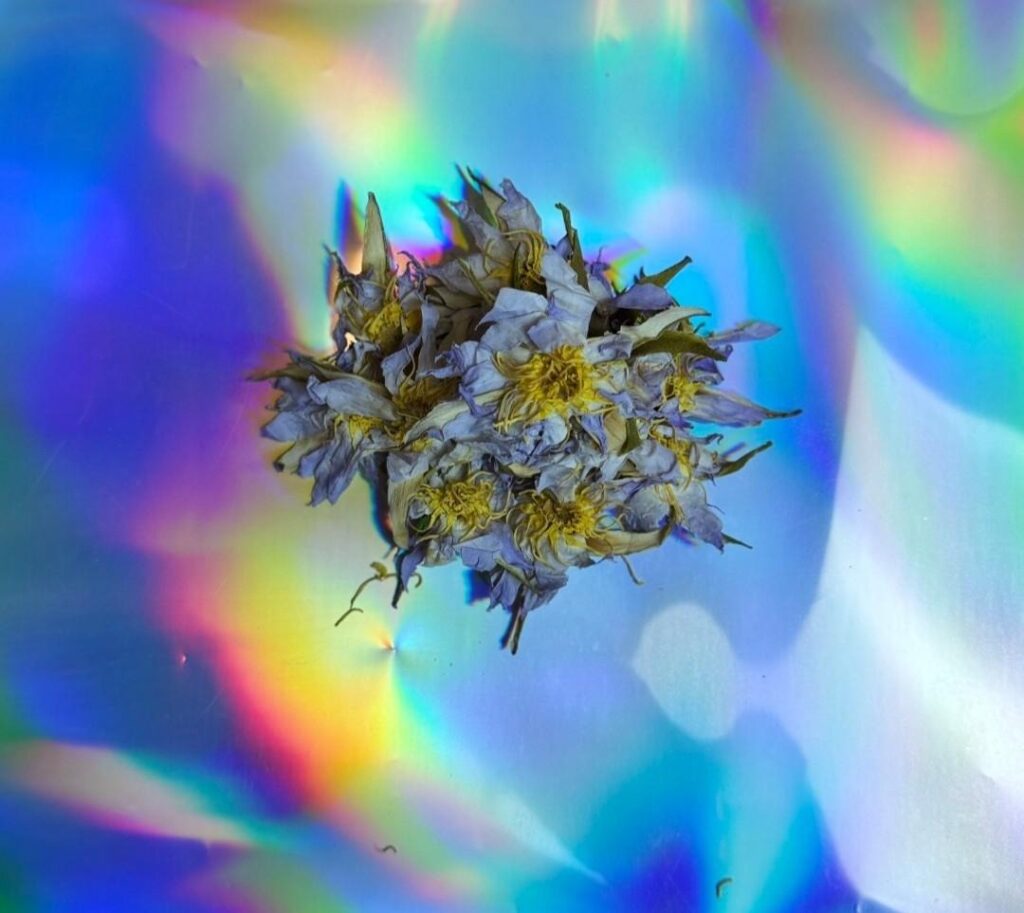
Buying tea is traditionally a very straightforward process, however diving into the complicated world of the spice trade reveals a complicated family of plants, unreliable common names, and a flower almost lost to history.
If you are recently seeing the new Mocktail scene exploding- that’s non-alcohol bars, culture etc Blue lotus is becoming a popular new addition. To the best of our knowledge Blue Lotus is a just a common name, not a precise latin/scientific name, which I believe encompasses quite a few species and/or subvarieties of plants on the market today. According to royal botanic gardens, an organization with over 425 scientists, Nymphaea nouchali, Nymphaea stellata, Nymphaea Capensis and over 40 other species, are all synonymous with Nymphaea Caerulea
This happens a lot with common names, and is kind of an issue amongst scientists in a lot of earth science fields, not just plants, but animals, fungi etc. For example, “sage” is a few species of plants such as Salvia officinalis, or Artemisia tridentata, Leucophyllum frutescens, this is all sage, of course you can break the wording up further like saying “texas sage” or “culinary sage” etc. This happens a lot, peppers are several species as well, tomatoes, etc. all considered by the the same common names. It’s funny a bit, common names are often made fun of on Plant ID forums/groups because they’re so unreliable – money plant comes to mind as commonly disregarded for true ID.
I think the Wikipedia article does a good job of this, reading the first paragraph describes several subspecies that all seem to have the common name blue lotus. This is a place we’re able to find “blue lotus” common name, notice a lot of subvarieties including caerulea.
Compared to Nymphaea nouchali var. caerulea – Wikipedia which, we found interesting enough does not immediately mention the common name blue lotus- although this is traditionally the variety known as blue lotus, which I think is a good reason to call it egyptian lotus, or maybe egyptian blue lotus to help people associate with history better, and differentiate from the hybrid counterparts even if lot of older sources just called this specific subspecies blue lotus as well.
I believe this is the root cause, and why we try to differentiate the sub varieties with what we believe based on taxonomical physical characteristics we’ve seen in write-ups from botanical academies (universities, organizations, etc). Even very reliable sources seem to describe the taxonomical traits differently, which has been frustrating, and I think our best sources are botanical gardens, academic centers etc. which have provided some good photos. We are currently sending samples for DNA barcoding to link them to public databases which I personally believe will be the only way to properly categorize the subspecies. This is not common ground for tea, supplements, or botanical specimens; typically if it looks like a duck, quacks like a duck, people will not typically test the genetics. However our team is dedicated to mapping the exact genetics of the common names blue lotus, thai blue louts, egyptian blue lotus etc.
Regarding egyptian lotus on our website- this was sold to us as egyptian lotus, and it really does appear to be so. Ours has the mottle sepals (dots on the bottom), the light blue leaves that fade to white, and are very whimsical as well, the grower that supplies it says it does not age well, and we notice as well I think this is why this species is not on the market- it loses it’s colors and turns white fast. So based on physical characteristics,our taxonomical research, we have little reason to think this is not an egyptian lotus variety. I don’t think N. Caerulea is hard to find, I think it’s hard to store and likely won’t be on the market much- just a few months on a shelf shows.
So to answer the question a bit quickly, to really help narrow down the species, it seems to depend on the name attached- like asian blue lotus varieties, or if it is labeled egyptian blue than it should be nymphaea ceruela, which is what we are currently testing for across all varieties to hopefully map the genetics in a publicaly accesaible DNA database like genbank, or inaturalist- this is something we are new to however very excited to dive into.
Here’s more interesting quotes to further emphasize how strange this subject can get:
“Nymphaea nouchali. The Blue Lotus, Nymphaea caerulea, and the Cape Blue Water Lily, Nymphaea capensis are no longer regarded as distinct species and have been sunk into this genus. The type specimen was collected in Coromandel in India. The meaning of the specific epithet nouchali has only been traced with the assistance of staff at Kew who report that one of their specimens contains a note that Noakhali is a district in Bangladesh. The variety name caerulea refers to the sky blue colour of the flowers. The following are all synonyms of this plant: Nymphaea capensis Thunb., N. caerulea Sav., N. calliantha Conard, N. mildbraedi Gilg., N. spectabilis Gilg., N. nelsonii Burtt Davy”
– Nymphaea nouchali var. caerulea | PlantZAfrica
as well as
“Nymphaea spectabilis, a purple form known from cultivation, and N. capensis, found throughout eastern, central and southern Africa, as well as a number of other named taxa, were synonymised to N. nouchali var. caerulea in the 1989 addition to the Flora of Tropical East Africa (FTEA)(2) series, a position which has generally been accepted” (1)
as well as the untied states department of agriculture recognizes I think over 28 synonyms as common name blue lotus (3)
Nymphaea nouchali Burm. f. GRIN-Global